The Next Web |
- WeChat wants to pay you $25 to recruit 5 US friends to its mobile messaging service
- Offline over the weekend? Read all the tech news you missed right here
- Amazon’s LoveFilm inks deals to stream more kids’ content
- You can now play Grand Theft Auto: San Andreas on Windows Phone 8
- Despite claims of a decline in the West, Facebook is stronger than ever in the rest of the world
- BSkyB pushes for more subscribers with an all-new YouTube channel airing first episodes for free
- Kantar: Android overtakes iOS on US sales, extends lead in Europe, Latin America and China
- LinkedIn to get a boost in China from its integration with popular messaging app WeChat
- LG ships record 13.2m smartphones in Q4 2013 to show Android isn’t all about Samsung
- China’s Alibaba launches mobile games on its Taobao shopping app and Laiwang chat app
| WeChat wants to pay you $25 to recruit 5 US friends to its mobile messaging service Posted: 27 Jan 2014 03:56 AM PST  WeChat, the popular messaging app that claimed Facebook's mantle in China, is sharpening its focus on the US market, after quietly launching a campaign to reward users for recruiting their friends. The Wall Street Journal first spotted the scheme that rewards users who connect their Google account and invite five friends to the service with a $25 gift card from Restaurants.com.
Tencent, the Internet giant that owns WeChat, focused on international growth last year, pushing the messaging app in South East Asia, South Africa and Latin America through a campaign spearheaded by Argentina and Barcelona football star Lionel Messi. Like Japanese rival Line, WeChat has done no real promotion in the US, but it did set up a small team to investigate opportunities one year ago. WeChat — which counts 100 million registered users outside of China, and has 272 million active users worldwide — will need to rival the likes of Snapchat, Kik, WhatsApp and Facebook Messenger for attention in the US. That's no easy task. If this promotion has caught your attention, you can learn more about the differences between WeChat and other messaging apps in our recent post: More than messaging: Why you should stop comparing WeChat to WhatsApp. Related: WeChat is going international in a different way to WhatsApp: using games and commerce [Interview] This posting includes an audio/video/photo media file: Download Now |
| Offline over the weekend? Read all the tech news you missed right here Posted: 27 Jan 2014 03:44 AM PST  It's Monday once again, which means it's time to make a coffee and take 10 minutes to catch up on the most exciting technology news that happened over the weekend. So, whether you slept through the whole two days or were just too busy with friends and family to keep up to date on what was going on, fear not, we were paying attention so that you didn't have to. Now all you need to do is make that coffee. Over the weekend from The Next Web:
Good reads
From beyond The Next Web
Featured Image Credit – Thinkstock This posting includes an audio/video/photo media file: Download Now |
| Amazon’s LoveFilm inks deals to stream more kids’ content Posted: 27 Jan 2014 03:32 AM PST
LoveFilm has announced three new streaming deals with kids' entertainment producers HIT Entertainment, Ludorum and DreamWorks Classics, as the Amazon-owned company looks to ramp up its child-friendly content. The deal brings familiar shows such as Thomas & Friends, Fireman Sam, Pingu, Where's Wally, Bob the Builder and Chuggington to Lovefilm Instant members, with new episodes of some shows appearing exclusively on LoveFilm to stream. This news follows August's announcement that it's adding more kids' content from NBCUniversal, including Curious George and Barbie: Princess Charm School, The Land Before Time, Maisy, and Rastamouse. LoveFilm has also retained the streaming rights for other hits, including He-Man and Postman Pat. But the fact that it has garnered exclusive first-run rights to feature length movies of Thomas & Friends in particular, will likely go down well with parents around the country. ➤ LoveFilm This posting includes an audio/video/photo media file: Download Now |
| You can now play Grand Theft Auto: San Andreas on Windows Phone 8 Posted: 27 Jan 2014 02:50 AM PST
A little more than a month after it first landed on iOS and Android, Grand Theft Auto: San Andreas has arrived for Windows Phone 8 users too. Developer Rockstar originally launched the game for the PlayStation 2 way back in 2004, and it has now been remastered for touchscreen mobiles. Costing $6.99, the game requires at least 1GB RAM and 2.5GB storage space, and is only officially supported by the Nokia Lumia: 1520, 1320, 822, 820 and 810, as well as the HTC 8XT. That said, it will likely still work on other devices, but perhaps with performance issues. ➤ GTA: San Andreas | Windows Phone Store [via WMPoweruser] This posting includes an audio/video/photo media file: Download Now |
| Despite claims of a decline in the West, Facebook is stronger than ever in the rest of the world Posted: 27 Jan 2014 02:39 AM PST  Barely a week goes by without Facebook facing one crisis or another, according to the media — usually relating to the fact that US teenagers are using other services more regularly. Most recently, boffins at Princeton used data to suggest 80 percent of users will leave Facebook by 2017. Facebook then humorously debunked that by using the same methodology to 'prove' Princeton's enrolment would halve by 2018, and that the world's air supply will disappear by 2060. Facebook under pressure in the US
Likewise, messaging app Kik is quietly cruising. Having crested 100 million users last year, it is also a popular choice for communication among youngsters in the US and elsewhere. Messaging apps are also appealing to older demographics — WhatsApp leads the charge with over 400 million active users. The service has become a key platform for daily messaging for many, evidenced by the fact that it now sees 18 billion sent messages per day — just 2 billion short of the estimated total number of SMS that are sent per day. Facebook's need to stay appealing to the youth market and mobile generation in the West is genuine — it is said to be preparing a suite of new apps to help supercharge its position — but what is all too often forgotten is the global context behind it. Global reachFacebook is far from in crisis. It has 1.1 billion active users. Yes, that's people who use it every month. In fact, 728 million people use the site or its mobile apps every day, 507 million of whom do so from a mobile device. That is huge and unprecedented. It dwarfs almost any other company on the Internet in terms of reach, perhaps only Google aside. But, more than just big figures, Facebook is still growing in many parts of the world where it is a key platform — even among competition from messaging apps and others. In parts of Asia, Africa and other emerging markets, Facebook is the Internet for the minority of people who have access (stats compiled by We Are Social show there is plenty of room for growth.) That's to say that they spend the majority of their time inside the service — communicating to friends, keeping up and sharing news, etc. Yet, they still also use messaging apps and others services, because Facebook provides a different kind of connection — it's a way to interact with extended networks of family and friends in a public way. Even in the business world, Facebook requests are increasingly commonplace. I started with a network of just personal friends and, five years after living in Asia, I've added a lot of work-related contacts even though I am very selective about how I expand my Facebook network.
No longer just an Internet servicePerhaps the most interesting observation I've seen from spending time across Asia, and more recently the Middle East, is how Facebook is seen by many as entirely separate to the Internet. Here's how a conversation with less tech savvy folks in Southeast Asia might go. (I also heard similar anecdotal comments in Jordan and Turkey while visiting recently.)
With smartphones the primary access point for so many in the emerging world, and carriers offering all-you-can-eat access to Facebook — among other services — it's no wonder that it transcends being merely a social network. It's become the Yellow Pages of the Internet: in many places, it is simply unthinkable not to be on, or regularly use the service. Challenges of being globalThe real question is how, as a business, Facebook adapts its money-making to this user base in emerging markets. Advertisers there are often more cautious and in possession of digital budgets that are far smaller than those in the West, while — in terms of users — there's a growing threat from messaging apps that do more than just chat (see: More than messaging: Why you should stop comparing WeChat to WhatsApp) and are expanding globally. Yet, the company has adapted its business model to mobile quicker than many expected, and it is still popular worldwide, so it remains in a good position. Perhaps the most fascinating aspect of Facebook's global appeal is Mark Zuckerberg's desire to connect the entire planet. It may seem like a nice soundbite to those in Silicon Valley, but, from what I've seen, Facebook is genuinely the service that brings people together more effectively than any other. Facebook's Internet.org project is still in its early days, having been launched last year, but it will be fascinating to see how successful it is in its objective to provide universal, global Internet access. Related: Don't discount Facebook Messenger from the messaging app race Images via ilolab / Shutterstock, Lionel Bonaventure /Getty Images/AFP, Spencer E Holtaway / Flickr This posting includes an audio/video/photo media file: Download Now |
| BSkyB pushes for more subscribers with an all-new YouTube channel airing first episodes for free Posted: 27 Jan 2014 02:16 AM PST UK satellite broadcaster BSkyB ('Sky') is kickstarting a massive marketing offensive in 2014, part of which involves letting anyone sample whole episodes on YouTube. Sky will launch an all new YouTube channel called 'Sky First Episodes' on February 1, where viewers can access full 'first' episodes, including the premier episode of Irish sitcom Moone Boy (Sky 1), Moonfleet, and A Young Doctor's Notebook. For returning shows, the channel will broadcast the very first episode of the inaugural series, and for brand new shows, the first episode will only hit YouTube AFTER it's been broadcast to subscribers. Indeed, the content airing on Sky First Episodes will be pulled in from across the broadcaster's range of entertainment channels, including Sky 1, Sky Atlantic, Sky Arts and Sky Living, with the company claiming to invest in the region of £600 million in British content this year. With the new YouTube channel in tow, Sky wants to hook you and tempt you to sign-up to a monthly contract. ➤ Sky launches biggest year of entertainment with major new marketing campaign | Press Release This posting includes an audio/video/photo media file: Download Now |
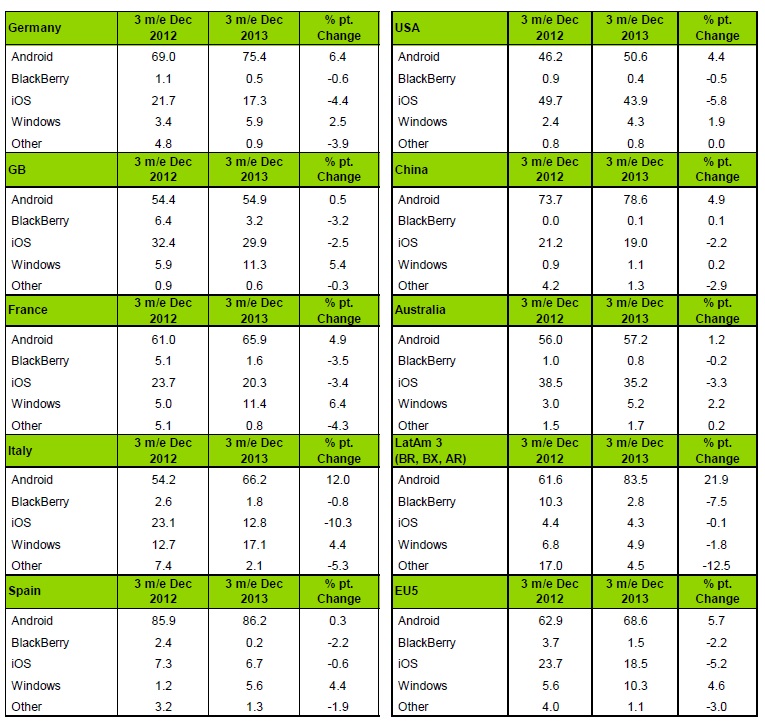
| Kantar: Android overtakes iOS on US sales, extends lead in Europe, Latin America and China Posted: 27 Jan 2014 02:00 AM PST  Android continues to hold court over the rest of the mobile industry in almost every global market, according to a new report from Kantar Research. The data shows that devices running the Google-owned operating system accounted for at least 50 percent or more of sales in the US, Europe, Latin America, Australia and China during the final three months of 2013. In some regions, Android's share of sales is over 75 percent, and it posted annual gains in each market that Kantar measured. The research firm found that Android retook the top spot in the US market, to account for an estimated 50.6 percent of smartphone sales between October and December 2013. That's just ahead of iOS (43.9 percent), while Windows Phone languishes some way behind in third (4.3 percent). The three platforms rank in the same order across Europe, although the margins differ considerably. Android holds a dominant 68.6 percent share of sales across — the five biggest European markets – UK, Germany, France, Italy and Spain — while iOS picks up second place with 18.5 percent and Windows Phone accounts for 10.3 percent. Those figures are based on averages across Europe, and vary from market to market. Windows Phone is, for example, ahead of iOS in Italy (where it holds 17.1 percent market share compared to Apple's 12.8 percent), although that is the only market where the order of the top three is different. Windows Phone also holds second place in Latin America, according to Kantar. Though it represented a mere 4.9 percent of sales during the three-month period, that is more than iOS (4.3 percent.) As is the case in Europe, Android dominates Latin America by a long stretch, holding an estimated 83.5 percent of sales. Finally, in China, the picture is a little different. Android leads the field — as it has done for some while — and accounts for 78.6 percent, an increase of 4.9 percent over the past year. iOS is the second most popular platform with 19 percent (though that is down 2.2 percent on the previous year), while Windows Phone limps in with 1.1 percent — that's actually less than the 'other' devices category that is not broken out by Kantar. BlackBerry continues to struggle worldwide. Market share is down in the US, Europe and Latin America, and it accounts for a negligible section of the market in each region — as you can see from the charts below.
Reflecting on the data, Kantar's Dominic Sunnebo explains that Apple has retained a strong presence in key markets despite its share of sales dropping over the past year. Sunnebo is less positive about Windows Phone, despite its consolidation in Europe:
Interestingly, Sunnebo has words of warning for Samsung, which he believes is "now coming under real pressure in most regions." Though Kantar's data is based on operating systems, the company says Samsung's market share is down 2.2 percent to 40.3 percent in Europe, while its share of the Chinese market remained flat at 24 percent. Image via etnyk / Flickr This posting includes an audio/video/photo media file: Download Now |
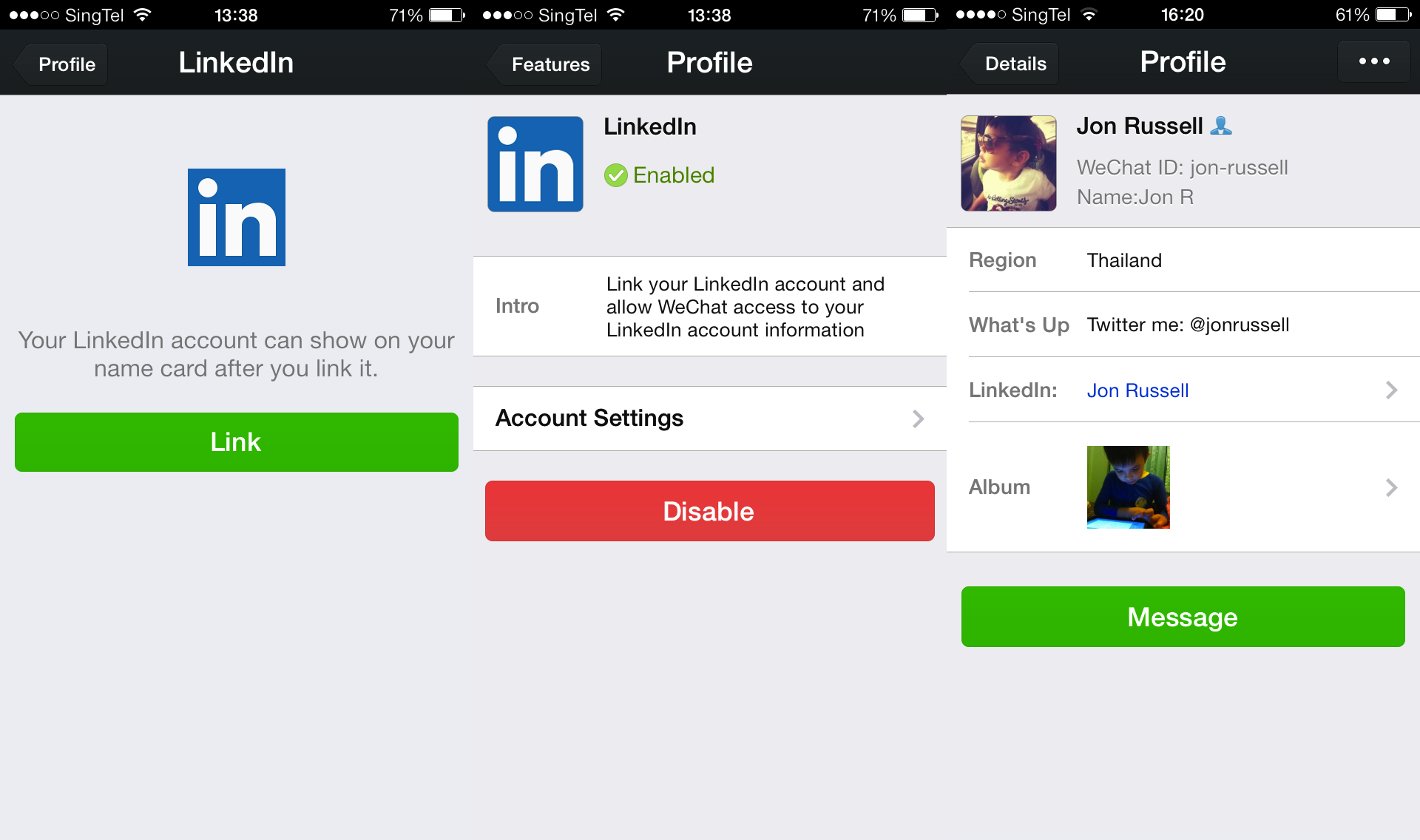
| LinkedIn to get a boost in China from its integration with popular messaging app WeChat Posted: 27 Jan 2014 01:49 AM PST  It looks like LinkedIn has progressed one more step in China after a WeChat update over the weekend revealed that the wildly-popular messaging service has integrated profiles from the career-focused social network. The latest update to both WeChat and Weixin, the version available in China, lets users link their LinkedIn account to WeChat. This would likely help to raise the profile of LinkedIn among WeChat's users, especially in China, given that the messaging service has an estimated 500 million plus registered users in the country alone. It has 270 million active users worldwide.
The latest development comes after LinkedIn made a move in the country earlier this month with the appointment of Derek Shen, the founder and former CEO of Chinese Groupon-like group-buying site Nuomi, as the president of LinkedIn China. LinkedIn founder Reid Hoffman also previously acknowledged the importance of the Android ecosystem to China. We speculated that this meant we could expect LinkedIn to focus its efforts on mobile in the world's largest smartphone market as well — and the company has delivered, albeit with a small step. The latest WeChat update also adds real-time location sharing with its Walkie Talkie voice feature, universal search including chat history search, notifications if you are mentioned in a group chat, as well as the ability to share sticker sets with friends. Headline image via Justin Sullivan/Getty Images This posting includes an audio/video/photo media file: Download Now |
| LG ships record 13.2m smartphones in Q4 2013 to show Android isn’t all about Samsung Posted: 26 Jan 2014 11:13 PM PST
The Korean company just announced its latest financial figures (PDF), which include a record 13.2 million smartphone shipments in its most recent quarter of business. That's an impressive 54 percent increase year-on-year, and a step up from the 12 million shipments of the previous quarter. On top of that, LG's mobile division posted a 29 percent increase on annual revenue ($11.85 billion), with the company citing "stronger" sales of LTE smartphones. This revenue and shipments are well short of what Samsung posts, but they are a healthy improvement. That said, LG did acknowledge that "the positive impact of improved product mix was offset by higher marketing investments to strengthen LG's brand equity and intensified price competition." Overall, LG posted an annual loss of $60.21 million across all business units. Related: LG G2 first impressions: Business in the front, buttons on the back ➤ LG: 4Q 2013 Performance Results Image via Seong Joon Cho/Bloomberg via Getty Images This posting includes an audio/video/photo media file: Download Now |
| China’s Alibaba launches mobile games on its Taobao shopping app and Laiwang chat app Posted: 26 Jan 2014 11:02 PM PST  Following the announcement of its intention to branch out into mobile gaming earlier this month, Chinese e-commerce giant Alibaba has launched today its first batch of games on its Taobao Mobile marketplace app, as well as its messaging service Laiwang. Android users can now visit 'Game Center' on the updated Taobao Mobile app to download the single game available there or 'Come Play' on Laiwang to download another two games that have been rolled out by Alibaba. The updates for the iOS apps are still pending, but will likely be live in the near future.
To tempt users to play its games, Alibaba is giving away chances to win points on Alipay — its payments service — and red packets containing digital cash for those who log in to the games through their Taobao accounts on the mobile app. These points and red packets can be redeemed at Taobao or Alibaba's two other e-commerce sites, Tmall and Juhuasuan. Laiwang users, however, won't enjoy this perk. Alibaba's push into mobile games comes as Tencent has been stepping up integration of its games into its wildly-popular messaging service WeChat (users in China get a version known as Weixin). In the first three months of introducing mobile games into Weixin, they passed 570 million downloads. By using perks to attract users, Alibaba could very well chalk up impressive game downloads and/or log-ins, but whether the games are actually being played is another matter altogether — which means the company may not be able to attract that many active users and therefore stickiness may not be as strong. However, it cannot be denied that Alibaba is extremely keen to make its presence felt in mobile, and games form another aspect of this overall push. CEO Jonathan Lu already pledged last year to continue its string of big investments as it maintains focus on improving its services for mobile — and the company has been upping efforts to promote its chat app, wooing mobile shoppers with free data and even giving free smartphones to retailers in China. Headline image via Peter Parks/AFP/Getty Images This posting includes an audio/video/photo media file: Download Now |





| You are subscribed to email updates from The Next Web To stop receiving these emails, you may unsubscribe now. | Email delivery powered by Google |
| Google Inc., 20 West Kinzie, Chicago IL USA 60610 | |