The Next Web |
- Report: China has 270m Android users – that’s nearly 30% of global Android activations to date
- Research suggests Microsoft has lifted censorship restrictions for new version of Skype in China
- Kim Dotcom’s cloud storage service Mega now has an iOS app
- Nokia announces the Lumia 525, an upgraded successor to the top-selling Lumia 520
- T-Mobile and AT&T went head-to-head on Twitter over a customer… T-Mobile won
- Microsoft is reportedly increasing its efforts to encrypt traffic passing through its services
- The New York Times says the future is unclear for its Chinese website, which is blocked in China
- PayPal adds support for prepaid gift cards, thanks to patent-pending ‘pay anytime anywhere with any card’ system
- Twitter appears to be experimenting with predicting viral tweets
- Nokia loses all its social media points with ‘F*** you’ tweet [update]
| Report: China has 270m Android users – that’s nearly 30% of global Android activations to date Posted: 27 Nov 2013 05:08 AM PST  The number of daily active Android users in China has surpassed 270 million, according to a new report from Baidu, China's dominant search company. To give an idea of the significance of that number, Google announced in September that it had activated a total of 1 billion Android devices to date — clearly China's smartphone (and indeed Android) market is enormous. Chinese Android app store Wandoujia recently estimated that more than 70 percent of Android smartphones in China lack Google Play services, which makes Baidu's data extremely valuable when it comes to dissecting information about Android users in the country. Most phones in China are also sold with Baidu or other default services replacing Google. Despite the Baidu report showing that new Android users in China have been growing at a slower pace throughout 2013, it also finds that Chinese Android users are spending more time on their mobile devices – 150 minutes per day, up by 26 minutes from the same quarter last year. They check their phones 53 times a day, up by 11.3 percent from a year earlier.
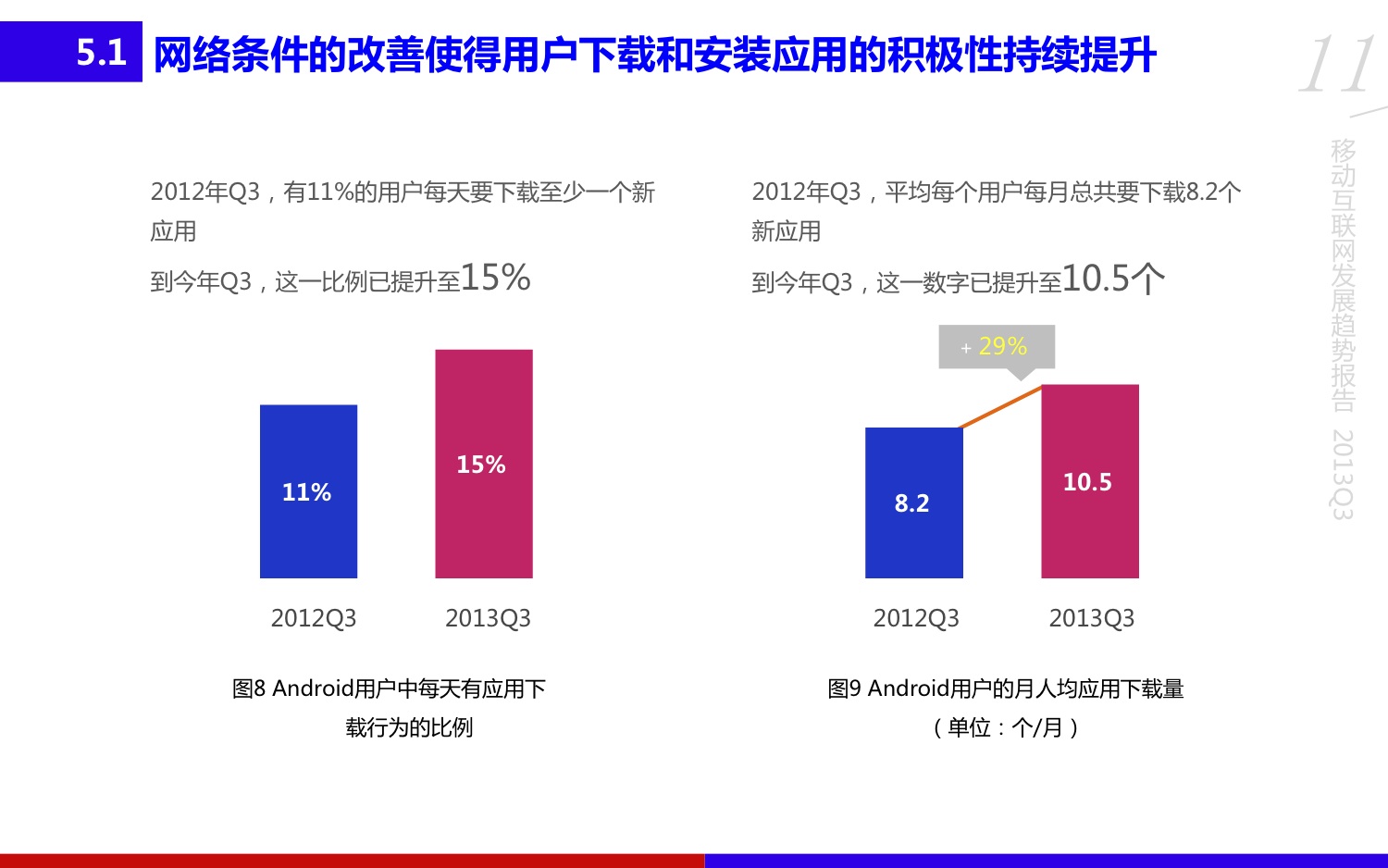
And Chinese Android users have a love for apps — on average, they downloaded 10.5 apps a month in Q3 2013, up from 8.2 times a year earlier. In the third quarter, 15 percent of users downloaded a new app a day — up from 11 percent a year earlier. China is already the world's largest smartphone market, and Baidu's data provides signs that the mobile revolution is spreading to new demographics. Third- and fourth-tier cities in China now make up 45 percent of Android users in the country, up from 35 percent in the same period last year. Despite the Chinese becoming increasingly connected, cellular connection is still not as robust or as cheaply available. The Baidu report finds that Wi-Fi is still the number one way for Chinese users to access the Internet — making up 46 percent of the total Internet access time, while they go online 31 percent of the time via 2G and a mere 23 percent via 3G. Among the Chinese Internet giants, it seems like Tencent is becoming the king of the Android mobile market. The Baidu report finds that Tencent takes top spot as the company with the most mobile apps installed on smartphones in China, with 3.6 apps on average, while Baidu takes second place with 2.5 apps. This is due to Tencent's strength in social networking apps — the report notes that in Q3 2013, Tencent-owned mobile QQ and WeChat occupy two of the top three apps in the social networking and chat apps category, which are the second-most downloaded group of apps following lifestyle and entertainment ones. Consequently, Tencent has the most number of daily active users, followed by Baidu — but both have more than 150 million daily active users. As the report is specific to Baidu, the search giant also notes that daily active users on its mobile search engine have surpassed 130 million, with 36 percent of the users accessing it daily. The latest Baidu report shows plenty of evidence that the world's largest smartphone market is a thriving Android marketplace — and this is something worth developers looking out for, though they would likely have to target third-party app stores, given how different the app store dynamic is in China. Headline image via Justin Sullivan/Getty Images This posting includes an audio/video/photo media file: Download Now |
| Research suggests Microsoft has lifted censorship restrictions for new version of Skype in China Posted: 27 Nov 2013 03:36 AM PST  Earlier this month, Skype ended its partnership with TOM Online, the mobile Internet company that managed its service in China; and yesterday it announced Guangming Founder (GMF) as the replacement. Speculation was rife that Microsoft would continue placing similar censorship restrictions on the Skype service, as it did during its partnership with TOM Online – allowing information to be processed by TOM and stored on servers located in China, in the absence of privacy controls. However, research from Chinese Web monitoring service GreatFire suggests that Microsoft has instead taken measures to remove mechanisms that allow for spying on users and their activity. It notes that currently, all user calls, chats and login information are encrypted and communicated directly to Microsoft via HTTPS. Furthermore, it appears that the China-specific Skype service is now using servers based outside of the country — and potentially out of reach of the censor-happy authorities in China. "This is a complete about face for Microsoft from the TOM-Skype era," GreatFire says in a blog post detailing its findings. We reported yesterday that Skype and GMF have started migrating users and updating the Skype software in China to a new version – which will be available for Windows 8.1, Mac, older Windows platforms, Android and iOS. GreatFire found that despite this version being different from the international version of Skype that supports Chinese — noting that the download link is hosted by GMF in China — it appears that Microsoft has retained full control of the new Skype. "The software is digitally signed by Microsoft, which means Microsoft and Microsoft alone is responsible for the software's code. The Chinese authorities cannot provide counterfeit software to users in China," GreatFire notes. The GreatFire team analyzed the communications passing through the new China-specific version of Skype, and found that there are no censored keywords — as communications pass through servers located in Singapore, the U.S and Ireland. Whether this will change further down the road is a different matter altogether — if it comes to the government's attention that Skype is skirting such censorship issues. It's fairly normal for overseas firms to adhere to censorship demands in order to do business in China — Japanese/Korean messaging app Line has developed a China-specific version of its service where communications are censored accordingly, for example. In the meantime though, GreatFire has praised Microsoft for making this change to its Skype service.
Headline image via Mario Tama/Getty Images This posting includes an audio/video/photo media file: Download Now |
| Kim Dotcom’s cloud storage service Mega now has an iOS app Posted: 27 Nov 2013 01:43 AM PST Mega, the cloud storage service run by Kim Dotcom now has an iOS app, following the introduction of an Android app back in July. The free-to-download app allows users to manage and move files stored in the service, as well as upgrade accounts with more storage space with a Mega Pro subscription, costing $10.99 per month or $119.99 per year. Mega Pro provides 50GB of storage and 1000GB of bandwidth transfers. It's worth noting that if you do go down the subscription route, they'll auto-renew monthly or annually. Now that the company's iOS app has arrived, it's only the promised sync clients for Windows, Mac and Linux desktops that we're waiting on, though Dotcom says it's coming soon. ➤ Mega [App Store] Featured Image Credit - flippnjj Disclosure: This article contains an affiliate link. While we only ever write about products we think deserve to be on the pages of our site, The Next Web may earn a small commission if you click through and buy the product in question. This posting includes an audio/video/photo media file: Download Now |
| Nokia announces the Lumia 525, an upgraded successor to the top-selling Lumia 520 Posted: 27 Nov 2013 12:12 AM PST  Nokia has extended its family of smartphones with the Lumia 525, an affordable device that succeeds the popular Lumia 520 – which is its top selling Windows Phone device worldwide. The new phone runs the latest Nokia Lumia Black of Windows Phone 8 and is powered by a 1 GHz dual-core Qualcomm Snapdragon processor and 1GB of RAM — both of which are an upgrade on the Lumia 520. The Lumia 525 keeps its older brother's four-inch touch screen (800 x 480 pixels) and includes the same five-megapixel camera, which supports HD video recording at 720p and 30 frames-per-second. The device comes with 8GB of on-board memory, and includes support for micro SD cards of up to 64GB — there's also 7GB of free SkyDrive storage thrown in for good measure. The phone is available with a choice of changeable covers: glossy orange, white, yellow and matte black.   The device was quietly announced out of Singapore today, where it will go on sale from December 14 priced at SG$249 (US$199). We've contacted Nokia for details of the international launch and price so stay tuned. Keeping the same price but bumping up the internals is a smart move, and the Lumia 525 is likely to be pushed hard in Asia and other emerging markets where its sibling grew into Nokia's top performer (back in July AdDuplex claimed it controlled 13.3 percent of the total Windows Phone market.) Like the Lumia 520, the 525 is unlikely to be launched in the US, where Nokia prefers to focus on higher-end devices. This new Lumia will bring more credible competition to the Moto G — now available off-contract from $179 — in the budget smartphone price range. This posting includes an audio/video/photo media file: Download Now |
| T-Mobile and AT&T went head-to-head on Twitter over a customer… T-Mobile won Posted: 26 Nov 2013 11:04 PM PST Conversations like this one are what makes Twitter an amazing service. If you considered switching your mobile operator in the past, you might chat with friends or family about it and then come to a decision. These days you can do more than that — why not put out a tweet too… you might attract the attention of those very same operators, and even T-Mobile's CEO himself. That's what happened to Jay Rooney, an AT&T customer who was tempted by T-Mobile's free international roaming deal. A T-Mobile rep replies just seven minutes later: That kicks off a battle for the customer as AT&T responds: T-Mobile gets right to the point: AT&T replies, looking more than a little defeated: But lo and behold T-Mobile CEO John Legere steps into the fold: And seals the deal: That's a pretty good outcome from just one tweet: You can read the full thread for yourself here. Thumbnail image via West McGowan / Flickr – hat tip Koushik Dutta
This posting includes an audio/video/photo media file: Download Now |
| Microsoft is reportedly increasing its efforts to encrypt traffic passing through its services Posted: 26 Nov 2013 09:56 PM PST
The encryption will take place "across the full range of consumer and business services," unnamed sources tell the newspaper. Microsoft's top lawyer Brad Smith has said that if documents — which suggest that Microsoft services are part of the NSA's targets — are proven true, this would be "very disturbing" and could possibly be a breach of the constitution. In response to NSA's alleged spying efforts, Google is accelerating its plans to encrypt the "torrents of information," while Yahoo will encrypt all information that moves between its data centers by the end of the first quarter next year. ➤ Microsoft, suspecting NSA spying, to ramp up efforts to encrypt its Internet traffic [Washington Post] Thumbnail image via Joe Raedle/Getty Images This posting includes an audio/video/photo media file: Download Now |
| The New York Times says the future is unclear for its Chinese website, which is blocked in China Posted: 26 Nov 2013 09:07 PM PST  China is a difficult country for media to maneuver, especially foreign ones which may bring to attention some issues that the Chinese government doesn't want thrust into the limelight. The government blocked the New York Times in October last year, and now it seems that move may actually bear fruit after the media giant admitted its Chinese-language website is under review. New York Times CEO Mark Thompson told Reuters that the Chinese-language website is a money-losing operation, and will therefore be kept under "constant review" — which could mean the end of the road for the site in the not-too-distant future. "The fact that we can't be seen officially inside China means the revenue is not as large as we would have wished it to have been," Thompson told Reuters, adding that Chinese officials haven't indicated in any way that the New York Times site could be unblocked soon. China blocked the New York Times after the paper published a report on the immense wealth that former Premier Wen Jiabao's family built up during his tenure. Other foreign publications to come under fire recently include Reuters and the Wall Street Journal — which Chinese Web monitoring site GreatFire reported were banned after they reported on news of JPMorgan Chase's link to Lily Chang, the daughter of former Chinese Prime Minister Wen Jiabao. In a defiant response to Chinese censorship, GreatFire launched a mirror site for Reuters China, which it says can be accessed within the country without the use of any circumvention tools. However, this move, though definitely a boon for readers in the country, wouldn't help the publications' business models — which would require some sort of working relationship with advertisers and such. With the New York Times forced to make a decision on its Chinese-language website and probably having to cease its operations in the absence of revenue streams, Google's executive chairman Eric Schmidt may have been too optimistic in predicting that government censorship will be wiped out in 10 years. ➤ New York Times CEO says Chinese language site under review [Reuters] Headline image via Shutterstock This posting includes an audio/video/photo media file: Download Now |
| Posted: 26 Nov 2013 08:55 PM PST PayPal today announced it has added support for prepaid gift cards, letting its users apply them to the purchase of products and services anywhere PayPal Checkout is available. PayPal claims it spent months of research and investigations before finding a "patent-pending and innovative way" to allow the usage of prepaid gift cards. Prepaid gift cards (such as those from Visa, American Express, MasterCard, and Discover) are now just another source of money for PayPal, in addition to its existing support of debit cards, credit cards, and banks. The company says this means you can now pay "anytime anywhere and with any card." The fine print is of course that "anywhere" is actually "anywhere that accepts PayPal." See also – PayPal and Samsung partner to make it easier to pay and get paid for apps, games, music, movies, and more and PayPal president is fascinated by Bitcoin, says company is 'thinking about' including the virtual currency Top Image Credit: Eric Piermont/Getty Images This posting includes an audio/video/photo media file: Download Now |
| Twitter appears to be experimenting with predicting viral tweets Posted: 26 Nov 2013 04:50 PM PST  It looks like Twitter is experimenting if they are able to predict which tweets are going to go viral with a new account that's extremely similar to previous experiments @magicrecs and @eventparrot. A mysterious new account (@magicstats) has appeared with a bio that reads as follows:
Despite the account being protected, we've gained some insight into how it works over the last few days. When a user tweets something that the service thinks will go viral, it favorites the tweet within a few minutes of it being sent. In both instances where @magicstats favorited our tweets, they received well over 100 retweets within a few hours. We're not 100% sure this is an official account yet, but the design and wording of the account similar to that of the previous experiments. The functionality that's being tested here could be a response to Favstar's service, which allows you to track how far a tweet travels and helps show just how popular a tweet is becoming before it goes viral. Twitter declined to comment on the experiment when contacted, but an earlier blog post detailing the company's policy on experiments remains in effect. This posting includes an audio/video/photo media file: Download Now |
| Nokia loses all its social media points with ‘F*** you’ tweet [update] Posted: 26 Nov 2013 03:46 PM PST Last week, we gave Nokia props for its mastery of Twitter with a zing against rival BlackBerry, but we're now rescinding those points after the @NokiaNZ account tweeted a simple "F*** you" today. As you'd expect, the post has since been deleted. We can think of a few explanations for it, such as hacking, a disgruntled employee, an account mixup, or a practical joke gone awry, but whatever it is, Nokia isn't going to be winning the Internets today. We've reached out to the company to see if we can find out what happened. Update: Nokia has posted an apology: Thumbnail credit: MARTTI KAINULAINEN/AFP/Getty Images This posting includes an audio/video/photo media file: Download Now |




![Screen Shot 2013 11 26 at 3.32.58 PM 520x259 Nokia loses all its social media points with F*** you tweet [update]](http://cdn1.tnwcdn.com/wp-content/blogs.dir/1/files/2013/11/Screen-Shot-2013-11-26-at-3.32.58-PM.png "Screen Shot 2013 11 26 at 3.32.58 PM 520x259 photo")
| You are subscribed to email updates from The Next Web To stop receiving these emails, you may unsubscribe now. | Email delivery powered by Google |
| Google Inc., 20 West Kinzie, Chicago IL USA 60610 | |